

Washing Machine Repair Sydney: Why Is My Washer Not Draining or Spinning?
A washing machine that will not drain or spin can leave clothes soaking wet and prevent the wash cycle from finishing properly. In some cases, the cause is something simple such as an unbalanced load, blocked filter or kinked drain hose. In other cases, the problem may involve the drain pump, motor, belt, door lock, sensor or electronic control system.
If basic checks do not solve the problem, professional washing machine repair in Sydney can help identify the actual cause before you spend money on replacement parts or a new appliance.
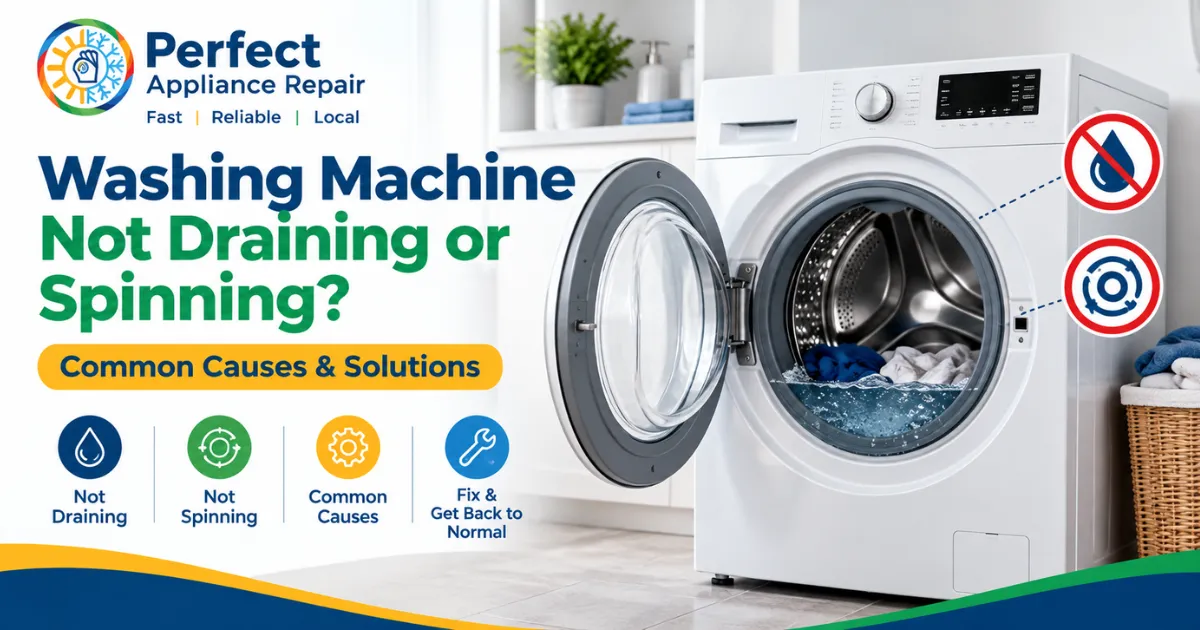
Quick Answer:
A washing machine may not drain or spin because of a blocked drain filter, restricted or kinked hose, unbalanced load, faulty drain pump, door or lid lock, worn belt, motor fault or an electronic problem. Some basic checks are safe to perform according to the manufacturer’s instructions, but persistent faults should be diagnosed by a qualified appliance technician.
Why Is My Washing Machine Not Draining or Spinning?
When a washer finishes part of its cycle but leaves water in the drum or refuses to spin, drainage and spin functions should be investigated together.
A washing machine normally needs to remove the water before it can complete a high-speed spin cycle. Therefore, a washer that is not spinning may actually have a drainage problem rather than a separate motor or belt failure.
Why Is My Washing Machine Not Draining?
Common causes include:
- Blocked drain filter
- Kinked or restricted drain hose
- Blocked drainage connection
- Faulty drain pump
- Excessive detergent or suds
- Sensor or control problem
- Internal mechanical fault
The exact cause depends on the make, model and symptoms.
Why Is My Washing Machine Not Spinning?
A washer may fail to spin because of:
- An unbalanced load
- An overloaded drum
- Water remaining in the machine
- A door or lid lock problem
- Worn or damaged belt
- Motor problem
- Sensor fault
- Electronic control issue
Before assuming the motor has failed, check whether the machine is also failing to drain.
What Should You Check When Your Washing Machine Won’t Drain?
Before booking a repair, there are a few basic checks you may be able to perform safely.
Always follow the appliance manufacturer’s instructions and disconnect the appliance from power before carrying out any user-level inspection that requires it.
1. Check the Washing Cycle
Make sure the machine has actually reached the drain or spin stage.
Some washing machines have separate rinse, drain and spin settings, while others may pause during a cycle when they detect an imbalance or another condition.
2. Check the Washing Load
An extremely heavy or uneven load can prevent the machine from spinning correctly.
For example, a single heavy towel, blanket or other large item may become concentrated on one side of the drum.
Pause the machine if the manufacturer’s instructions allow it, redistribute the load and try the appropriate cycle again.
3. Inspect the Drain Hose
Look for obvious kinks, crushing or visible restrictions in the drain hose.
A restricted hose can prevent water from leaving the machine properly.
Do not force objects into the hose to clear a blockage.
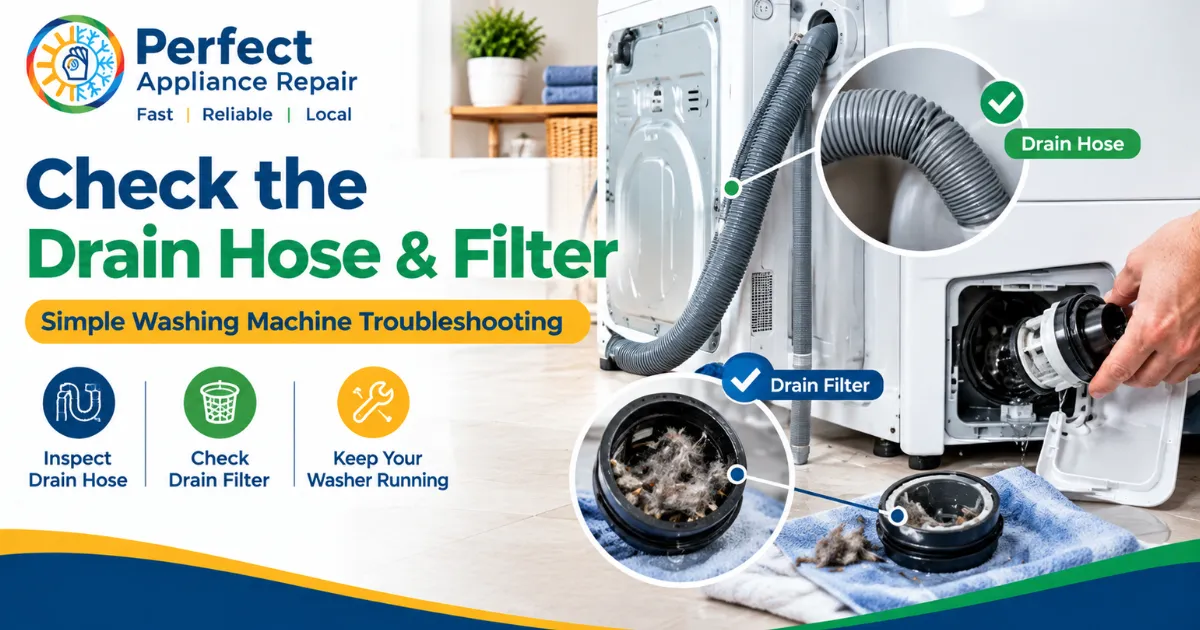
4. Check the Drain Filter if It Is User-Accessible
Many washing machines have a filter designed to catch debris before it reaches the pump.
Depending on the model, the filter may be accessible to the homeowner.
Before opening it:
- Switch the appliance off
- Disconnect power where appropriate
- Follow the manufacturer’s instructions
- Prepare for residual water
- Never force a component that does not open as designed
If you are unsure how to access the filter safely, leave the inspection to a technician.
5. Consider Excessive Detergent
Using more detergent than recommended can create excessive suds and interfere with normal washing and drainage performance.
Use the detergent type and quantity recommended for your washing machine and water conditions.
What Should You Check When Your Washing Machine Won’t Spin?
If water has been removed but the drum still will not spin, there may be a different fault.
Check Whether the Load Is Unbalanced
Redistribute clothes evenly around the drum and run the appropriate cycle again.
Check Whether Water Is Still Inside the Drum
If the machine cannot drain properly, it may prevent or limit the spin cycle.
This is why checking drainage should normally come before assuming there is a motor failure.
Check the Door or Lid
Many washing machines will not enter a high-speed spin cycle unless the door or lid is correctly closed and locked.
Do not attempt to bypass a safety lock.
Check for an Error Code
If the display shows an error code, record it before switching the machine off.
Your model’s user manual may explain what the code means.
An error code can provide useful diagnostic information, but it does not always mean that one specific component must automatically be replaced.
Washing Machine Not Draining? Common Causes Explained
Blocked Drain Filter
A filter can collect lint, coins, hairpins, small objects and other debris.
If the filter becomes restricted, water may drain slowly or fail to drain completely.
Blocked or Kinked Drain Hose
A damaged, kinked or restricted hose can prevent the pump from moving water out of the appliance.
Faulty Drain Pump
The drain pump is responsible for moving water away from the washing machine.
Signs of a possible pump problem can include:
- Humming without proper drainage
- Water remaining in the drum
- Slow drainage
- Repeated drainage errors
- Unusual pump noise
A pump problem generally requires professional diagnosis if basic checks have not resolved the issue.
Drainage Connection Problem
The washing machine itself may be working correctly while the external drainage connection is restricted or incorrectly configured.
A technician can help determine whether the fault is inside the appliance or related to the drainage setup.
Control or Sensor Fault
Modern washing machines use electronic controls and sensors to manage different stages of a cycle.
A sensor or control problem can cause the machine to stop before draining or spinning correctly.
Washing Machine Not Spinning? Common Causes Explained
Unbalanced Load
An uneven load is one of the simpler explanations for a machine refusing to spin at full speed.
The washer may detect excessive movement and reduce or cancel the spin cycle.
Overloaded Washing Machine
Overloading can place additional stress on the appliance and prevent normal operation.
Always follow the manufacturer’s recommended load capacity.
Drainage Problem
If water remains in the drum, the washing machine may not proceed to a normal spin cycle.
This is why a drainage diagnosis should often come first.
Door or Lid Lock Fault
The machine may prevent spinning if its safety system does not detect that the door or lid is securely locked.
Worn or Damaged Belt
Some washing machines use belts to transfer motor power to the drum.
A worn or damaged belt can cause the drum to stop rotating correctly.
Motor Problem
Motor faults can affect drum movement, but motor failure should not be assumed simply because the washer is not spinning.
Proper testing is needed.
Sensor or Control Board Fault
Electronic faults can create unusual symptoms, including interrupted cycles, failed spinning or repeated error messages.
These problems should generally be diagnosed by a technician rather than repaired through trial and error.
Can I Fix a Washing Machine That Won’t Drain Myself?
Some basic troubleshooting may be appropriate for a homeowner.
Safe Basic Checks You Can Try
Depending on your model and manufacturer’s instructions, you may be able to:
- Check the selected cycle
- Reduce or redistribute the load
- Inspect the visible drain hose
- Check a user-accessible filter
- Check for an error code
- Confirm that the appliance has power
These checks should not require you to dismantle the washing machine.
Problems You Should Leave to a Technician
Professional assistance is appropriate when the problem may involve:
- Drain pump replacement
- Motor faults
- Belt replacement
- Internal wiring
- Control boards
- Sensors
- Door-lock mechanisms
- Electrical faults
- Internal mechanical components
Opening an appliance or working on electrical components without the appropriate knowledge can create a safety risk and may cause additional damage.
When Is a Washing Machine Drainage Problem an Emergency?
Not every washer problem requires emergency service, but some symptoms should not be ignored.
Stop using the appliance and seek appropriate professional assistance if you notice:
- Heavy water leakage
- Smoke
- Burning smells
- Sparking
- Exposed electrical wiring
- Repeated circuit-breaker trips
- Severe mechanical noises
- Unusual overheating
If water has reached electrical components, do not continue operating the appliance simply to see whether it completes the cycle.
Safety should come before attempting a DIY repair.
How Much Does Washing Machine Repair Cost in Sydney?
There is no single price for washing machine repair because the cost depends on the problem and the work required.
A simple blockage or hose issue can be very different from a failed pump, motor or electronic component.
Factors that can affect the final repair cost include:
- Diagnostic requirements
- Labour
- Replacement parts
- Appliance brand and model
- Appliance age
- Accessibility
- Complexity of the fault
- Parts availability
For broader information about appliance repair pricing, see our guide to appliance repair cost in Sydney.
Should You Repair or Replace Your Washing Machine?
A washing machine that stops spinning does not automatically need to be replaced.
Repair May Make Sense When:
- The appliance is relatively new
- The fault is isolated
- Replacement parts are available
- The appliance is otherwise in good condition
- The repair cost is reasonable
- The machine has been reliable previously
Replacement May Be Worth Considering When:
- The appliance is very old
- It has experienced repeated major failures
- Several components are failing
- Parts are difficult or impossible to obtain
- The repair cost is close to the cost of a suitable replacement
- The appliance has become unreliable overall
The right decision depends on the individual appliance.
A professional diagnosis gives you more useful information than guessing based on the symptom alone.
Common Washing Machine Repair Mistakes Sydney Homeowners Make
Continuing to Run a Leaking Machine
A small leak can become a larger water problem.
If the appliance is leaking significantly, stop using it and investigate safely.
Repeatedly Restarting the Washer
Turning a faulty machine off and on repeatedly does not fix an underlying mechanical or electrical problem.
Using Too Much Detergent
Excessive detergent can create unnecessary suds and may affect washing and drainage performance.
Overloading the Drum
An overloaded or badly balanced machine can experience excessive movement and poor spinning performance.
Ignoring Error Codes
If an error code keeps appearing, record it and consult the manufacturer’s documentation or a qualified technician.
Replacing Parts Without Diagnosis
Buying and installing a pump, motor or control board simply because the machine will not spin can be an expensive mistake.
The symptom does not always identify the failed component.
Attempting Electrical Repairs
Internal electrical repairs should be left to appropriately qualified professionals.
Washing Machine Problems That May Look Like a Drainage Fault
Some washing machine problems can produce similar symptoms.
The Machine Stops Before the Spin Cycle
This may be related to drainage, load balance, a door-lock system or another fault.
Clothes Are Still Soaking Wet
This can happen when the machine has not completed its spin cycle or cannot remove water correctly.
The Door Will Not Unlock
Some machines keep the door locked while water remains inside or when a safety condition has been detected.
The Drum Does Not Move
A drum that does not rotate may involve a belt, motor, control system or another component.
The Machine Makes a Humming Sound
A humming sound during attempted drainage can indicate that the pump is operating under abnormal conditions, although the sound alone cannot confirm the exact fault.
An Error Code Appears
The code may help narrow down the affected system, but proper diagnosis is still important before replacing components.
What Information Should You Give a Washing Machine Technician?
When booking a washing machine repair service in Sydney, providing accurate information can help the technician understand the job.
Have the following details available:
- Washing machine brand
- Model number
- Approximate age
- Front-loader or top-loader
- Exact problem
- When the problem started
- Whether water remains inside
- Whether the drum spins at all
- Any error code
- Unusual sounds
- Unusual smells
- Visible leaks
- Whether the machine has recently been moved
For example, saying:
“The washing machine stops before spinning and there is still water in the drum”
is more useful than simply saying:
“My washing machine is broken.”
How a Professional Washing Machine Repair Technician Diagnoses the Problem
Professional diagnosis should be based on the actual symptoms and appropriate testing rather than guessing.
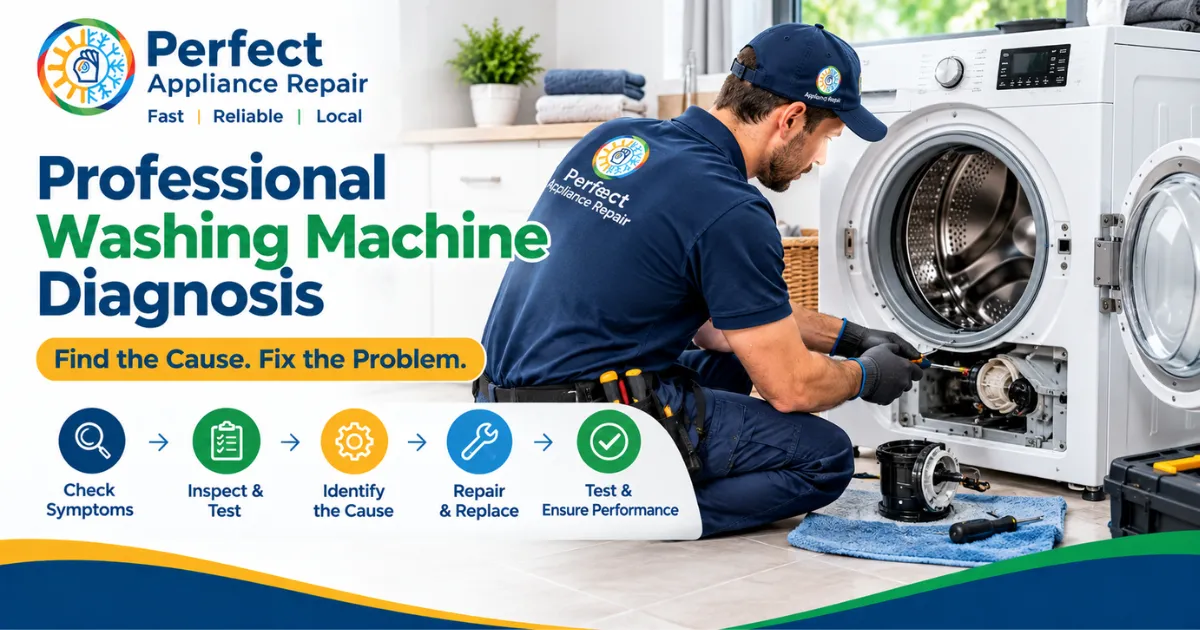
1. Understand the Symptoms
The technician asks what happened, when the problem occurs and whether there are any error codes or unusual sounds.
2. Inspect the Appliance
The appliance and relevant visible components are inspected for obvious signs of damage or blockage.
3. Test the Relevant System
Depending on the symptoms, the technician may investigate drainage, spinning, electrical, mechanical or control-related components.
4. Identify the Likely Cause
The objective is to determine which component or system is causing the problem.
5. Explain the Repair Options
The customer should understand what has been identified and what repair is recommended.
6. Provide a Quote
Where applicable, repair costs should be explained before additional work is approved.
7. Test the Appliance After Repair
After the approved repair, the washing machine should be tested where practical to confirm that the relevant problem has been addressed.
This diagnosis-first approach helps reduce unnecessary parts replacement.
What Washing Machine Brands Can a Sydney Technician Repair?
Appliance technicians may service multiple washing machine brands, depending on their experience, equipment and access to suitable parts.
Common brands found in Australian homes include:
- Bosch
- Miele
- Samsung
- LG
- Fisher & Paykel
- Electrolux
- Westinghouse
- Asko
- AEG
- Beko
- Haier
- Hisense
- Whirlpool
- Simpson
Brand support can vary by model and appliance age.
Before booking, provide the technician with the exact model number where possible.
Washing Machine Repair Service Across Sydney
If you need washing machine repair in Sydney, local service coverage can include residential properties across metropolitan Sydney.
Sydney CBD and Inner Sydney
Service areas may include Sydney CBD, Burwood, Campsie, Lakemba, Marrickville, Strathfield and Concord.
Western Sydney
Service may extend to Parramatta, Auburn, Merrylands, Granville, Guildford, Wentworthville, Lidcombe and Ermington.
South-West Sydney
Common service locations include Fairfield, Cabramatta, Liverpool, Bankstown, Yagoona, Georges Hall, Punchbowl, Revesby and Padstow.
Southern Sydney
Service areas can include Rockdale, Hurstville and Kogarah.
Sydney Olympic Park
Washing machine repair may also be available around Sydney Olympic Park and nearby suburbs, subject to service availability.
Always confirm your suburb and appliance details when booking because service coverage and technician availability can vary.
Why Choose a Professional Washing Machine Repair Service in Sydney?
When a washing machine stops draining or spinning, the goal should not simply be to replace the first part that seems likely to have failed.
A professional service should provide:
Accurate Diagnosis
The technician should investigate the underlying problem rather than relying only on the symptom.
Experience With Different Appliance Types
Experience with different washing machine designs can help technicians approach faults more systematically.
Clear Communication
Customers should understand what has been found and what repair is being recommended.
Appropriate Parts
Replacement parts should be suitable for the appliance’s make and model where available.
Repair Testing
The appliance should be tested after the approved repair where practical.
Honest Repair-or-Replace Advice
A good technician should be willing to explain when a repair may no longer be economical rather than automatically recommending expensive work.
Why Choose Perfect Appliance Repair for Washing Machine Repair in Sydney?
When you contact Perfect Appliance Repair, the aim is to identify the washing machine problem and provide a practical repair recommendation based on the appliance and its condition.
The service covers residential washing machine repairs and can also support commercial washing machine requirements where applicable.
Perfect Appliance Repair works with a range of appliance brands and common washing machine faults, including drainage, spinning, leaks, unusual noises and other operating problems.
The most useful information you can provide before booking is the brand, model number and exact symptom. This helps the technician understand what type of appliance is involved and what may be required for the service.
If a fault falls outside the technician’s scope, requires specialist licensing or depends on unavailable parts, the appropriate next step should be explained rather than making an unsupported repair promise.
E-E-A-T recommendation for this section: Add a real technician photo, real technician name, verified years of experience, relevant qualifications/licences where applicable, and a genuine customer repair example. These details should come from your actual business records.
Frequently Asked Questions About Washing Machine Repair in Sydney
Why is my washing machine not draining?
A washing machine may not drain because of a blocked filter, restricted drain hose, drainage connection problem, faulty drain pump or control-related fault. If basic manufacturer-approved checks do not resolve the problem, professional diagnosis can identify the underlying cause.
Why is my washing machine not spinning?
A washing machine may not spin because of an unbalanced load, overloaded drum, drainage problem, door or lid lock issue, belt problem, motor fault or electronic control issue.
Can a blocked filter stop a washing machine from spinning?
Yes. If a blocked filter prevents the machine from draining correctly, the washer may not proceed to its normal spin cycle. Check the filter only if it is designed to be user-accessible and follow the manufacturer’s instructions.
Can an unbalanced load stop a washing machine from spinning?
Yes. Modern washing machines can detect excessive imbalance and may reduce or stop the spin cycle to prevent excessive movement and vibration.
Should I unplug my washing machine before checking the filter?
If you are performing any user-level inspection that requires access to the appliance, follow the manufacturer’s safety instructions and disconnect the appliance from power where instructed. Never work on internal electrical components yourself unless appropriately qualified.
Is a washing machine that won’t drain worth repairing?
It may be. The decision depends on the appliance’s age, condition, fault, parts availability and repair cost. A professional diagnosis can help determine whether repair is a sensible option.
How much does washing machine repair cost in Sydney?
Washing machine repair costs vary depending on the fault, labour, parts, appliance model and diagnostic requirements. A blocked hose or filter can be very different from a motor, pump or electronic control problem.
When should I call a washing machine repair technician?
Call a technician when basic checks do not resolve the problem, the machine repeatedly fails to drain or spin, or you notice leaks, burning smells, unusual mechanical noises, electrical problems or recurring error codes.
Can a washing machine drain pump be replaced?
A faulty drain pump can often be replaced when a suitable component is available and replacement is appropriate for the appliance. The technician should confirm the pump is actually responsible for the problem before replacing it.
Do washing machine technicians repair different brands?
Many appliance technicians work across multiple brands, but coverage depends on the model, appliance age, technician experience, tools and replacement-part availability.
Book Washing Machine Repair in Sydney
A washing machine that will not drain or spin does not necessarily mean that you need a new appliance.
The problem could be something relatively simple, such as an unbalanced load or restricted hose, or it could involve a pump, motor, belt, door lock, sensor or electronic component.
Start with the basic checks recommended by your appliance manufacturer. If the problem continues-or if you notice a leak, burning smell, electrical fault or serious mechanical noise-professional diagnosis is the safer and more reliable next step.
If you need washing machine repair in Sydney, contact Perfect Appliance Repair with your appliance brand, model number, suburb and description of the problem.
Need a washing machine technician in Sydney? Book a professional appliance repair service today.